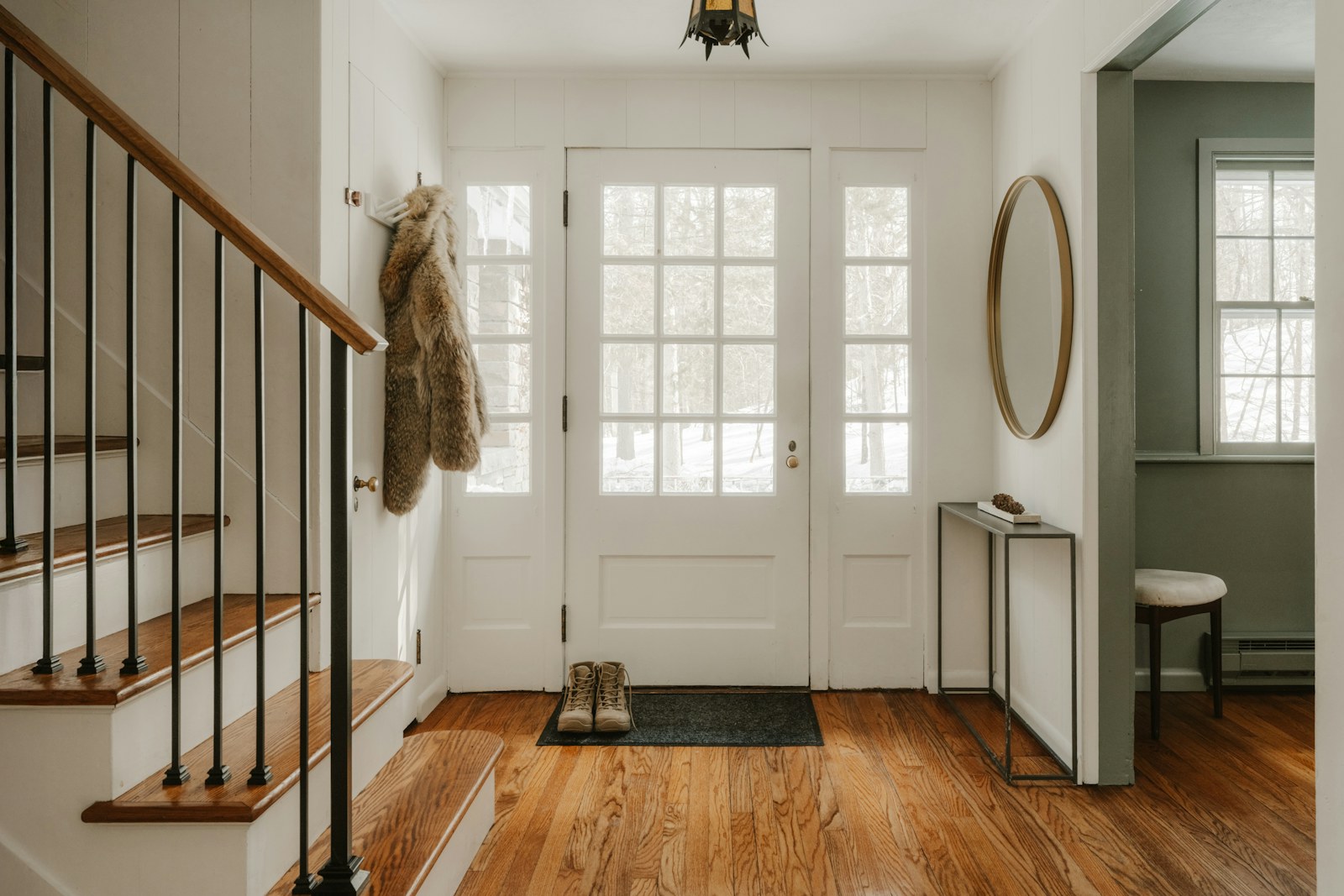
Photo: Clay Banks / Unsplash.
A narrow entryway without a closet needs a clear limit on what lives there. If every coat, pair of shoes, shopping bag, and unopened envelope arrives at the front door and stays, a slim cabinet will eventually feel as crowded as a deep one. Start by deciding what the entrance must do during an ordinary day.
The method below is for organizing the entrance you already have. It does not require a built-in mudroom or a collection of matching baskets. You will map the route, choose a small set of everyday belongings, and test a place for each before buying storage.
Watch one ordinary arrival and departure
Notice what you carry when you come home. Keys may need a quick landing place, a work bag may need to stay packed, and wet shoes may need somewhere appropriate to dry. Then watch what happens when you leave. Which items are you looking for? Which belongings do you move out of the way before the door can open?
Write down the sequence rather than describing the room as messy. For example: open door, set bag on floor, remove shoes, put keys on kitchen counter, leave mail on bag. That sequence shows where an arrangement could help. It also reveals when the best solution belongs beyond the entryway.
Ask everyone in the household to contribute. A child carrying a school backpack and an adult using a mobility aid may need different access. Organizing works better when the people using the space can reach their belongings without undoing someone else’s arrangement.
Protect the route before choosing furniture
Open the front door fully and note its swing. Check nearby interior doors, stairs, heating equipment, switches, and anything that needs routine access. Measure the entryway’s width and length, then sketch the fixed features. Mark the area that must remain clear for the household to move comfortably and safely.
Do not treat the full wall length as available storage. A cabinet may fit against the wall while its open doors block the passage. A bench may fit under a window while someone sitting on it occupies the only route. Test the furniture in use, not only in its closed position.
This guide does not supply universal hallway or accessibility clearances. Requirements depend on the property and applicable rules. Keep exits unobstructed, follow any building requirements, and seek qualified advice if a proposed change affects access or safety.
Choose what deserves an everyday place
Divide the belongings currently in the entry into three groups: used almost every day, used occasionally, and passing through. Daily shoes and a current jacket may belong near the door. Holiday footwear, spare tote bags, and several seasons of outerwear usually need a different home if the entrance is narrow.
Passing-through items need a destination and a deadline. A parcel waiting to be returned is not the same as a permanent storage item. Put the next action in your calendar or task list, and assign a temporary place that does not obstruct the door. Otherwise, temporary items quietly become part of the furniture.
Set a capacity based on the actual space. You might allow one current jacket and one everyday pair of shoes per person, provided that fits the household. The exact number is less important than choosing a limit everyone understands and can maintain.
Give keys and small essentials one landing place
Start with the smallest problem. A shallow dish or divided tray on an existing stable surface may be enough for keys and a transit card. Put it where the person carrying those items naturally pauses, while keeping valuables appropriately out of public view.
A tray is useful only if its contents remain recognizable. Avoid filling it with batteries, loose screws, old receipts, and every object found elsewhere in the house. Give those items their own destinations. A clear key spot should still work when you arrive with groceries and need one hand free.
If there is no safe surface by the door, place the landing spot a little farther into the home. It is better to walk a few steps to a consistent place than to install an awkward shelf that catches sleeves or narrows the passage.
Handle shoes with a realistic limit
Count the shoes that are actually worn during the current week. Separate those from occasional pairs and footwear that needs cleaning, repair, or a seasonal move. You may discover that the entry needs a modest shoe arrangement rather than a cabinet large enough for the entire collection.
Before buying a rack, measure the shoes themselves, including boots and larger sizes. Check whether they fit without projecting into the route. If a cabinet tilts open, include its operating space and follow the manufacturer’s installation and anchoring directions.
Choose an arrangement suited to the floor and local weather. Check beneath any tray or mat for trapped moisture and follow the flooring manufacturer’s care advice. A wet-shoe solution should protect the surface without becoming a permanent pile that nobody can inspect.
Find a home for current coats and bags
When there is no closet, it is tempting to hang a long row of hooks across the available wall. First, test how far a coat or filled bag projects when hanging. The hook itself may be shallow, but the belongings can take up much more room.
Use wall-mounted storage only with permission where needed and with hardware appropriate to the wall and intended load. Follow product instructions. An adhesive hook is not automatically suitable for a heavy work bag, and a freestanding coat stand is not automatically stable when loaded unevenly.
If hanging storage cannot fit safely, move coats to a nearby room or another suitable closet. A narrow entryway does not have to perform every function of a mudroom. It needs to let people arrive, leave, and move through without a daily obstacle course.
Make paper a short stop
Mail becomes difficult when every envelope has the same destination: a growing pile near the door. Decide where you will sort it and where important documents will be stored. The entrance may need only a small temporary tray, or it may not need paper storage at all.
Keep private correspondence out of view from the doorway. Follow appropriate handling for documents containing personal information. Set aside a regular moment to deal with the tray, using a system that fits your household rather than purchasing several organizers before deciding what they are for.
A useful test is whether you can describe the next action for every item. Pay, file, read, return, and recycle are different actions. If a paper stays because nobody knows what to do with it, adding a prettier basket will not resolve the decision.
Test a bench instead of assuming you need one
A place to sit while putting on shoes can be useful, but a bench is not mandatory. Try the proposed location with a suitably stable seat you already own, if one can be used safely there. Check the door swing and route while someone is seated.
Measure the whole piece and consider who will use it. An extremely shallow decorative bench may not provide comfortable or appropriate seating. A storage bench also needs room for its lid or drawers to operate without trapping fingers or blocking access.
If the entrance cannot accommodate seating, identify a nearby place that can. Store footwear so it can be carried there easily. The goal is a workable routine, not a checklist of furniture that every entryway is supposed to contain.
Use a one-week trial before shopping
Make a temporary version using belongings you already have: a small tray, an existing shelf, or a suitable container. Keep the arrangement simple and stable. Label places in plain language if several people share them, then use the entrance normally for a week.
Notice where items repeatedly miss their assigned place. The location may be inconvenient, the container may be difficult to open, or the capacity may be unrealistic. Change the arrangement in response to the pattern. Avoid interpreting every misplaced bag as a reason to buy another bin.
At the end of the week, list only the storage gaps that remain. Include measurements and the function required. Shopping for a specific shallow container that fits an existing shelf is easier than shopping for something to organize the entryway.
Keep storage stable and accessible
The U.S. Consumer Product Safety Commission recommends anchoring furniture and televisions to reduce tip-over risks. Follow the instructions supplied with a cabinet or shelving unit, including the specified anchoring method. If you cannot install a required anchor, choose a different arrangement or obtain qualified help.
Check the entry after it is loaded with real belongings. Look for projecting handles, trailing straps, slipping mats, unstable stacks, and items blocking switches or doors. Avoid storing heavy objects where someone must reach awkwardly above their head to retrieve them.
For entrances that open straight into a sitting room, plan the two spaces together. Our guide to a small living room with two doorways explains how to map the movement route before placing the main seating group.
Give the arrangement a brief reset
Choose a regular time to return occasional belongings to their proper homes and clear the temporary items. Check the shoe area, put papers through the agreed process, and confirm that the door opens freely. Keep this reset short enough that it can happen during an ordinary week.
Revisit the capacity when seasons or routines change. Winter outerwear, school bags, or a new work schedule may require a different arrangement. Move out what is no longer needed before adding storage for the new items.
An organized narrow entryway without a closet is a small system with a clear purpose. It holds the essentials you need at the door, sends other belongings to better places, and leaves room for people to move. When that works consistently, the entrance has done its job.
Safety reference: U.S. Consumer Product Safety Commission: Anchor It. Storage examples and the one-week trial are editorial planning suggestions, not an assessment of your property.
Featured photograph: Clay Banks / Unsplash, used under the Unsplash License.